For years, artificial intelligence discussions focused on model size, processors, and training speed. Those elements still matter, but production AI systems expose another constraint: value depends not only on how much information a system can process, but also on whether it can retain, retrieve, and reuse that information over time.
A model can produce an impressive answer in one session. A dependable AI workflow must also locate source files, preserve project history, reuse approved corrections, and incorporate new information without starting over. This capability is persistent context, and it turns storage from a passive repository into part of the operating AI system.

What Is Persistent Context?
Persistent context is information an AI application can carry across tasks or sessions. It usually does not live permanently inside the language model. Instead, it is stored in databases, object stores, local drives, network storage, or other repositories and retrieved when needed.
· Source documents and media
· Previous prompts, outputs, and approved corrections
· Embeddings, indexes, and metadata
· Application logs, workflow state, and version history
· Evaluation results, provenance, and access records
Retrieval-augmented generation illustrates this process. Documents are collected, divided into usable sections, indexed, and retrieved to provide context for a new request. The model generates the response, while the surrounding data architecture determines which evidence and history the model can use.
Why One-Time AI Interactions Are Not Enough
Early AI experiments often upload a file, complete a task, return an answer, and discard most intermediate information. This is suitable for demonstrations but limiting in daily operations.
If a design team repeatedly uploads the same assets and explains the same naming rules, earlier corrections are lost and approved descriptions cannot be reused. Retaining selected context allows the system to find similar assets, compare versions, reuse approved terminology, and preserve traceable decisions. The real benefit is continuity, not capacity alone.
Storage Becomes Part of the Workflow
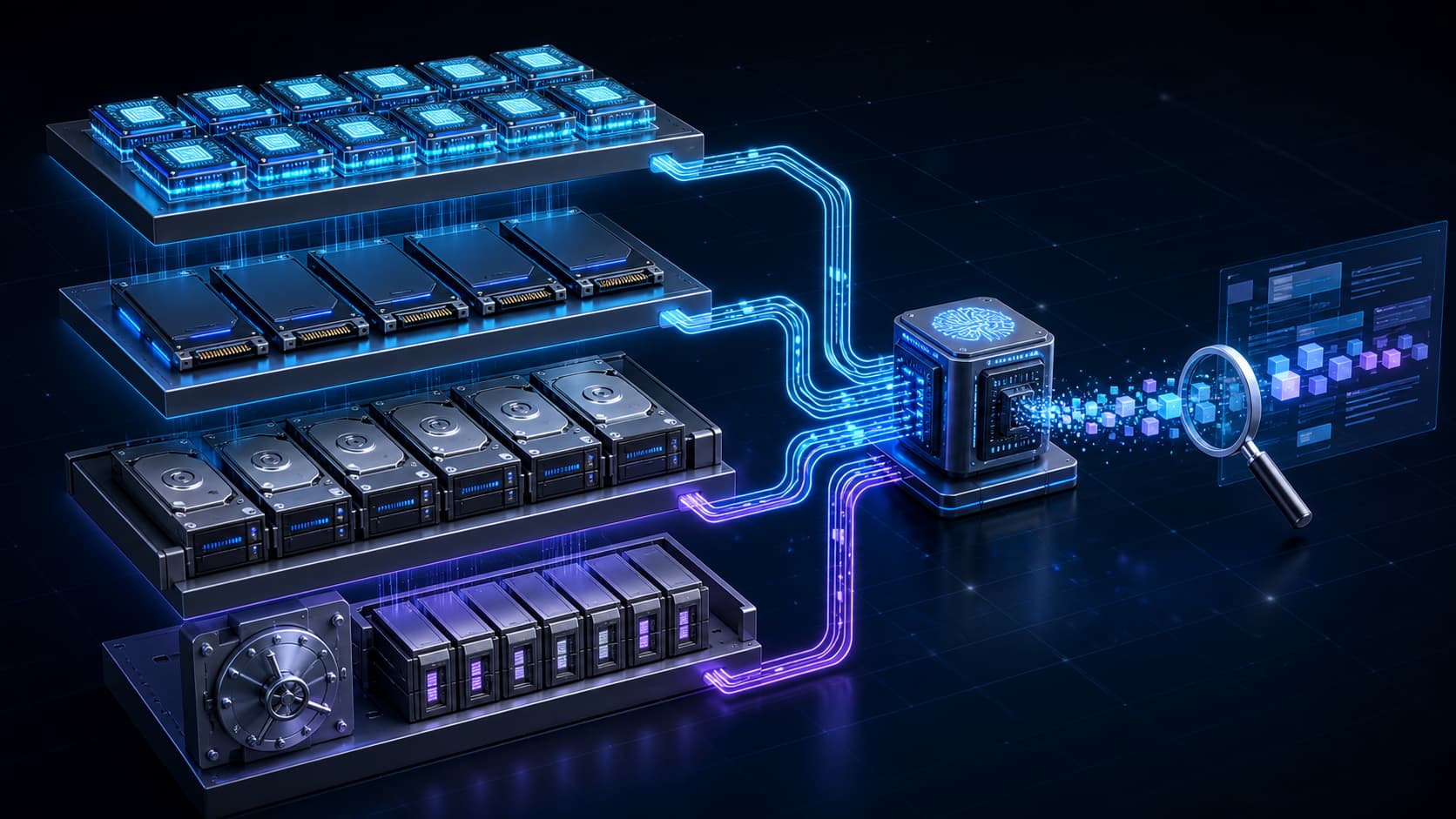
Traditional storage planning separates active data from archives. AI makes that boundary less predictable. An older product image may become relevant to visual search, an earlier brief may explain a current requirement, and historical support records may contain the evidence needed for a new answer.
| Tier |
Primary role |
Typical data |
| Memory |
Immediate application state |
Temporary context and cache |
| Fast SSD |
Frequently accessed working data |
Active datasets, indexes, current projects |
| Capacity storage |
Retained source and output data |
Documents, media, generated assets |
| Backup/archive |
Recovery and governance |
Independent copies and long-term records |
Composite Scenario: A Small Video Team
The following scenario is illustrative and does not represent a PURPLELEC customer or measured deployment.
A video team uses an AI assistant to search transcripts, suggest clips, and prepare project summaries. Recent projects work well, but historical files are scattered across devices, folder names are inconsistent, and some transcripts are separated from their original footage. The model is unchanged; the missing component is accessible history.
· Store source media in a consistent project structure
· Keep active files on fast working storage
· Move completed projects to capacity storage
· Link transcripts and metadata to original media
· Retain approved tags and summaries
· Maintain independent backups and access controls
Five Questions Before Expanding AI Storage
1. What is worth retaining?
Keeping everything creates cost and governance risk; deleting everything prevents reuse of validated history. Classify data by value and sensitivity.
2. How quickly must it be retrieved?
Interactive files may need fast access, while historical material can tolerate delay. Test the workflow, not just the interface label.
3. Will the information remain understandable?
Names, identifiers, timestamps, versions, permissions, and provenance determine whether retained data can be found and trusted.
4. How will the system handle growth?
AI workflows create derivatives such as thumbnails, transcripts, embeddings, previews, logs, and generated outputs.
5. How will trust be protected?
Persistent context can contain personal data, confidential files, copyrighted material, or incorrect outputs, so access, retention, deletion, and provenance controls matter.
Local Storage Still Has a Role
Cloud infrastructure suits many distributed workloads, but local SSD and HDD storage remains useful for media ingestion, private document collections, local model experiments, dataset preparation, project handoff, backup, and temporary processing before cloud upload.
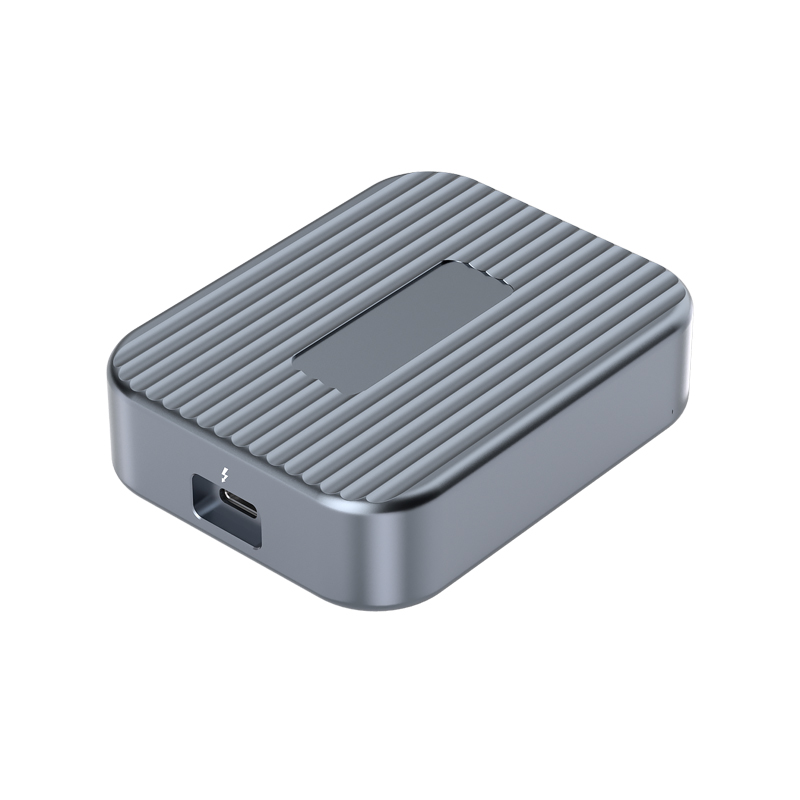
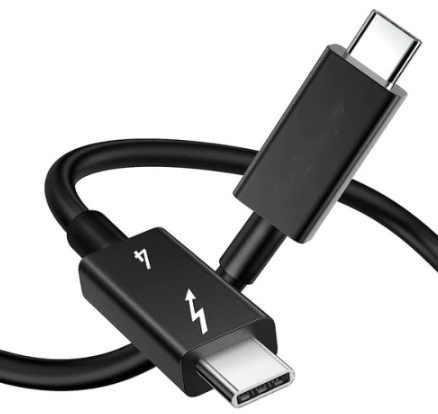
An enclosure, dock, or direct-attached drive does not create AI memory by itself. It provides physical capacity and connectivity within a broader workflow. Compatibility and performance depend on the drive, enclosure controller, cable, host interface, cooling, power, file system, and software workload.

Persistent Does Not Mean Permanent
· Retain temporary processing files only as long as necessary
· Preserve approved outputs and source assets according to business requirements
· Delete sensitive data when its authorized purpose ends
· Keep backups separate from working copies
· Record who changed or approved important information
The next stage of AI adoption will depend not only on models and processors, but also on whether organizations can preserve useful knowledge and retrieve it at the right moment. Persistent context requires coordinated storage tiers, metadata, search, security, backup, and lifecycle management.
PURPLELEC develops connectivity and data-access hardware, including docking solutions, SSD/HDD enclosures, USB hubs, and related computer accessories. OEM and ODM development is available for qualified projects.