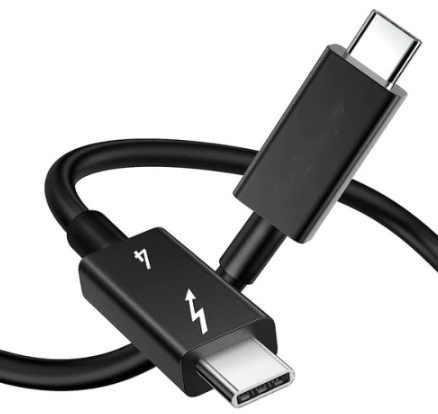
As hardware technology evolves, USB interface naming conventions have undergone multiple adjustments. Frequent changes to technical specifications and commercial names by the USB Implementers Forum (USB-IF) often mean that interfaces with the exact same transfer speeds carry different labels depending on the era. To optimize the efficiency of matching hardware devices, this article systematically outlines the current naming system driven by "data transfer rates" (e.g., USB 5Gbps, USB 40Gbps) and deeply analyzes the core differences between various generations of USB standards and Thunderbolt interfaces.
I. Differences Between Physical Connectors and Transfer Protocols
Before diving into USB standards, it is necessary to clarify the boundary between physical connectors and underlying protocols:
Physical Connectors: Refers to the hardware shape of the plugs and receptacles, such as the traditional USB Standard-A/B and the now ubiquitous USB Type-C.
Transfer Protocols (Protocols/Standards): Determine the actual performance parameters of the interface, including data throughput and expansion features (e.g., USB 10Gbps). During the USB 3 era, while introducing the Type-C connector, backward compatibility with older protocols was still maintained in specific scenarios.
II. The Development Timeline of Consumer USB Transfer Protocols
1. The Basic-Speed Era: USB 1.0/1.1 and USB 2.0
USB 1.x: Introduced between 1996 and 1998, offering 1.5Mb/s (Low-Speed) and 12Mb/s (Full-Speed) bandwidth, primarily serving early keyboards, mice, and printers.
USB 2.0 (High-Speed): Released in 2000, data transfer rates jumped significantly to 480Mb/s. It introduced Mini and Micro connectors, becoming the standard configuration for early mobile devices.
2. The High-Speed Transfer Era: The Evolution of the USB 3 Protocol Suite
Since 2008, the USB standard entered the "SuperSpeed" phase, with its complex naming system peaking during the 2017 "Gen" era. Today, industry marketing has fully shifted to straightforward speed ratings.
| Initial Release Year |
Early Commercial Name |
2017 Specification Label |
Current Standard Naming (Rate) |
Applicable Physical Connectors |
| 2008 |
SuperSpeed |
USB 3.2 Gen 1x1 |
USB 5Gbps |
Standard-A, Type-C |
| 2013 |
SuperSpeed+ |
USB 3.2 Gen 2x1 |
USB 10Gbps |
Standard-A, Type-C |
| 2017 |
SuperSpeed+ (Dual-Lane) |
USB 3.2 Gen 2x2 |
USB 20Gbps |
Type-C Only |
Cable and Power Specifications in the USB 3 Era:
Passive data cable length limits: The recommended maximum length is 2 meters (6.6 ft) for 5Gbps; it is advised to keep the length within 1 meter (3.3 ft) for 10/20Gbps.
Power Delivery: Traditional Standard-A data ports offer a base power of 4.5W (5V/0.9A), reaching up to 7.5W with BC 1.2 support. Type-C data ports start at 7.5W, and if integrated with the USB PD (Power Delivery) fast-charging protocol, the theoretical peak can reach 240W (though most downstream ports on PC terminals are usually limited to 15W).
3. The Architecture Innovation Era: USB4 (40Gbps / 80Gbps)
Launched in 2019, the USB4 protocol strictly requires the USB Type-C connector. Unlike previous standards, USB4 introduces protocol tunneling technology, enabling the simultaneous transmission of USB data and DisplayPort video signals, with optional support for PCIe data streams. This provides extreme bandwidth allocation flexibility for external storage, high-resolution displays, and high-performance docking stations.
Technical Specifications: Covers USB4 Gen 3x2 and Gen 4x2, with commercial naming simplified to USB 40Gbps and USB 80Gbps.
Cable Limits: Passive USB4 data cables supporting 40Gbps are typically limited to 0.8 meters (2.6 ft) or less, while remaining compatible with up to 240W PD fast charging.
III. Compatibility Matrix Between Thunderbolt and USB Standards
Thunderbolt and USB technologies developed independently in their early stages but achieved deep integration following the popularization of Type-C.
1. Thunderbolt 1/2: Used the mini-DisplayPort physical connector and operated independently of the USB ecosystem.
2. Thunderbolt 3: Fully transitioned to the Type-C connector, allowing hosts to connect to USB devices up to USB 10Gbps. However, it is important to note that Thunderbolt 3 peripherals generally will not work on non-Thunderbolt, standard USB Type-C ports.
3. Thunderbolt 4 & Thunderbolt 5: Thunderbolt 4 is highly synergized with USB4 technical specifications, establishing a stricter mini-mum performance baseline; Thunderbolt 5 pushes the maximum bandwidth to 80Gbps while maintaining deep backward compatibility.
4. Compatibility Guidelines: Thunderbolt 3 hosts support basic USB devices (up to 10Gbps); Thunderbolt 4/5 hosts are fully compatible with USB4 peripherals; meanwhile, standard USB4 hosts are also backward compatible with Thunderbolt 3 and Thunderbolt 4 devices.
IV. Hardware Deployment and Docking Station Purchasing Guide
For enterprise IT deployment and individual tech enthusiasts, understanding these protocol differences is crucial for making informed purchasing decisions.
1. Docking Station Purchasing Strategy: If your laptop is equipped with a Thunderbolt port, purchasing a Thunderbolt docking station offers the optimal solution for multi-screen ultra-HD output and high-throughput data processing. For office environments that need to accommodate multi-brand device compatibility, docking stations based on the USB 3.x standard combined with DisplayLink technology are a safer baseline choice.
2. Display Output Technology: DisplayLink transmits video signals over the USB bus, making it highly suitable for text-based office work and multi-monitor expansion needs (especially for Mac devices that natively only support a single external monitor). For graphics-intensive tasks involving 3D rendering or high-framerate video editing, it is recommended to use native GPU direct channels (such as Type-C DP Alt Mode or Thunderbolt interfaces).
3. PD Power Matching: A docking station's power output must match the host's energy consumption needs. Thin-and-light laptops (Ultrabooks) typically use the 60W standard; high-performance laptops require 85W to 100W of power; while the latest mobile workstations or desktop-replacement PCs rely on power supplies supporting EPR (Extended Power Range) technology at 140W to 240W.